Now Available on Amazon

ROAD
NAVIGATION

The Principles Explained

With Advice on the Driving Test

By R T Scanlon

Buy on Amazon.co.uk
200
Pages
14
Chapters
14
Illustrations
+
Glossary & Index

MORE THAN FOLLOWING INSTRUCTIONS

Road navigation has changed dramatically. Drivers now rely on satnav, smartphone apps, and in-car systems to guide them almost anywhere. Yet effective navigation still depends on more than following instructions.

Drivers must observe the road ahead, interpret signs and road layouts, anticipate what is coming next, and make safe decisions in good time. This book explains how.

"This book explains the principles behind effective road navigation and shows how satnav can be used intelligently rather than passively."

β€” From the back cover

"A clear framework for planning a journey, maintaining awareness while driving, and avoiding common navigation errors."

β€” road-navigation.com
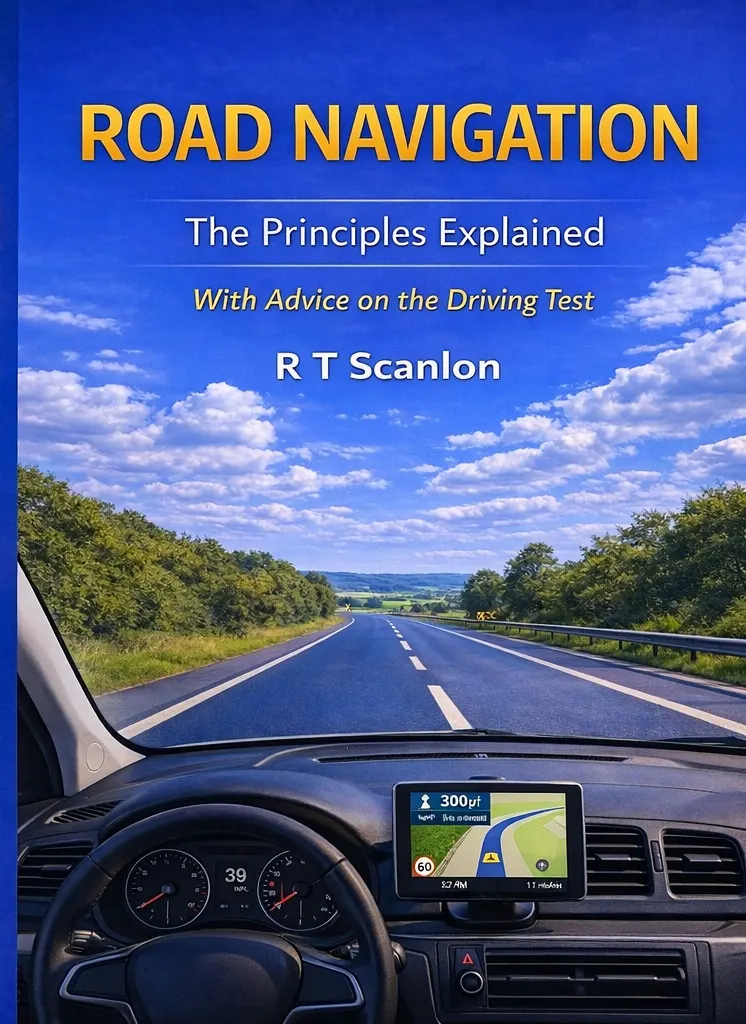
Road Navigation book cover by R T Scanlon

ROAD
NAVIGATION

The Principles Explained

With Advice on the Driving Test

by R T Scanlon

This book explains the principles behind effective road navigation and shows how satnav can be used intelligently rather than passively. It provides a clear framework for planning a journey, maintaining awareness while driving, and avoiding common navigation errors.

It also includes practical advice on satnav use in the UK driving test β€” invaluable for learner drivers and instructors alike.

200 Pages 14 Chapters 14 Illustrations Glossary Index
Buy on Amazon.co.uk Amazon.com

KEY TOPICS COVERED

πŸ—ΊοΈ

NAVIGATION PRINCIPLES

How to read the road ahead, interpret signs and layouts, and anticipate what is coming β€” going beyond what the satnav tells you.

πŸš—

INTELLIGENT SATNAV USE

How to use satnav actively rather than passively β€” understanding its limitations and using it as a tool, not a crutch.

πŸ“‹

DRIVING TEST ADVICE

Specific guidance on the independent driving section of the UK driving test, including the satnav element introduced in 2017.

🧭

JOURNEY PLANNING

A clear framework for planning routes, understanding road types, and making good decisions before you set off.

⚠️

COMMON ERRORS

Why navigation mistakes happen and how to avoid them β€” from missed turnings to wrong-way junctions and GPS errors.

πŸ™οΈ

ALL ROAD TYPES

Motorways, dual carriageways, urban roads, and rural lanes β€” how navigation challenges differ and how to handle each.

R T SCANLON

Author Β· Navigator Β· Driving Educator

R T Scanlon holds a higher degree in management and has extensive experience using satnavs while driving. He is the author of the original 2012 book How to Get More from Your Satnav, which established him as a leading voice on the practical use of navigation technology for everyday drivers.

Road Navigation: The Principles Explained builds on that foundation, covering the full breadth of road navigation β€” from foundational principles through to modern satnav use and UK driving test preparation.

Road navigation has changed dramatically. Drivers now rely on satnav, smartphone apps, and in-car navigation systems to guide them almost anywhere. Yet effective navigation still depends on more than following instructions.

Drivers must observe the road ahead, interpret signs and road layouts, anticipate what is coming next, and make safe decisions in good time.

This book explains the principles behind effective road navigation and shows how satnav can be used intelligently rather than passively.

Buy on Amazon.co.uk Amazon.com

ORDER
YOUR COPY

Available now on Amazon in paperback and Kindle editions. Choose your store below.

Available on Amazon

CHOOSE YOUR STORE

Available in paperback and Kindle editions.

ARTICLES

Short reads on satnav, judgement and the six principles of road navigation

Featured

Why I Wrote the Book

How a background in quality assurance shaped a preventative, error-reducing approach to road navigation.

02

RN Live Traffic

Modern satnavs constantly revise the route in real time. Is that helpful advice, or an unwanted backseat driver?

03

Website RN Live Traffic

Live Traffic is best treated as advice, not instruction. A companion look at how to weigh a rerouted suggestion.

04

Hang On… This Can't Possibly Be Right

What happens when the driver and the satnav disagree, and why information is not the same as judgement.

05

Lost Delivery Driver

A delivery driver's phone lost signal and he lost an hour. What separates a satnav failure from a navigation failure.

06

Beyond the Satnav

Why professional drivers check satellite imagery and Street View before trusting the satnav's final approach.

07

How Professional Drivers Really Use Satnav

What UK truck drivers said on Reddit about the tools and habits they rely on alongside a satnav.

08

What Truck Drivers Can Teach Us About Using Satnavs

Why the postcode only gets you so far, and how experienced drivers question the satnav rather than obey it.

09

Why Road Navigation Still Matters in the Satnav Age

Satnav should assist the driver, not replace the driver's thinking.

WHY I WROTE THE BOOK

My background in management and quality assurance inevitably influenced the way I viewed road navigation. Rather than seeing satnav as a device that simply gives directions, I came to see navigation as a process that can be planned, managed, and improved.

The questions I naturally asked were:

  • Where can the process fail?
  • How can those failures be prevented?
  • What systems can be put in place to reduce errors before they occur?

Most satnav users see the device as something that tells them where to go. I came to see it as only one component of a complete navigation system in which the driver plays the central role.

My six navigation principles are therefore more than driving techniques. They represent a quality assurance framework for navigation, encouraging drivers to prevent errors rather than simply recover from them.

In many ways, this book is not really about satnavs. It is about navigation as a managed process. The principles are based not only on driving experience but also on the philosophy of preventing errors before they occur rather than merely correcting them afterwards.

Good navigation, like good quality assurance, is fundamentally preventative. A few minutes spent planning, confirming, familiarising, observing, anticipating and positioning can prevent the costly consequences of a wrong decision later in the journey.

I believe the approach advocated in this book could just as easily be applied to map reading. The technology may change, but the principles do not. The six principles are a timeless, preventative approach to road navigation, helping drivers reduce errors regardless of whether they use a satnav, a paper map or future navigation technologies.

Preventing errors before they occur, rather than merely correcting them afterwards.

Buy on Amazon.co.uk

RN LIVE TRAFFIC

Helpful Adviser or Unwanted Backseat Driver?

Many drivers have noticed that modern satnavs behave differently from the devices of a few years ago. A route that seemed settled at the start of the journey can suddenly change. A voice announces: ‘A faster route is available.’ Two minutes later, the original route may be preferred again.

For some drivers this feels helpful. For others, it can be frustrating and unsettling.

Traditional satnavs planned a route and generally stuck to it unless the driver made a mistake. Modern systems such as Google Maps and Waze constantly monitor traffic conditions. They use information from thousands of other users to estimate delays, identify congestion, and suggest alternatives while the journey is already underway. The route is no longer fixed. It is being revised continuously.

The problem is that the satnav is usually trying to answer one question: ‘How can I get there fastest?’ Drivers may be asking a different question: ‘How can I get there safely and with the least stress?’

The quickest route may involve unfamiliar roads, multiple lane changes, difficult junctions, or narrow country lanes. Saving a few minutes is not always worth the extra workload.

Live Traffic is best seen as advice rather than instruction. A suggested route change should be considered, not automatically obeyed.

Ask yourself:

  • Can I make this manoeuvre safely?
  • Am I comfortable with the alternative route?
  • Is the time saving significant?
  • Would staying on the current route be simpler and safer?

If the answer is no, it is often perfectly reasonable to continue as you are.

Missing an opportunity to save a few minutes is rarely a serious problem. Making a hurried decision to catch a changing instruction can be.

Modern satnavs are powerful tools, but they do not remove the need for judgement. In many ways, Live Traffic has made navigation skills more important than ever.

The satnav guides. The driver decides.

Buy on Amazon.co.uk

WEBSITE RN LIVE TRAFFIC

Helpful Adviser or Unwanted Backseat Driver?

Many drivers have noticed that modern satnavs behave differently from the devices of a few years ago. A route that seemed settled at the start of the journey can suddenly change. A voice announces: ‘A faster route is available.’ Two minutes later, the original route may be preferred again.

For some drivers this feels helpful. For others, it can be frustrating and unsettling.

Traditional satnavs planned a route and generally stuck to it unless the driver made a mistake. Modern systems such as Google Maps and Waze constantly monitor traffic conditions. They use information from thousands of other users to estimate delays, identify congestion, and suggest alternatives while the journey is already underway. The route is no longer fixed. It is being revised continuously.

The problem is that the satnav is usually trying to answer one question: ‘How can I get there fastest?’ Drivers may be asking a different question: ‘How can I get there safely and with the least stress?’

The quickest route may involve unfamiliar roads, multiple lane changes, difficult junctions, or narrow country lanes. Saving a few minutes is not always worth the extra workload.

Live Traffic is best seen as advice rather than instruction. A suggested route change should be considered, not automatically obeyed.

Ask yourself:

  • Can I make this manoeuvre safely?
  • Am I comfortable with the alternative route?
  • Is the time saving significant?
  • Would staying on the current route be simpler and safer?

If the answer is no, it is often perfectly reasonable to continue as you are.

Missing an opportunity to save a few minutes is rarely a serious problem. Making a hurried decision to catch a changing instruction can be.

Modern satnavs are powerful tools, but they do not remove the need for judgement. In many ways, Live Traffic has made navigation skills more important than ever.

The satnav guides. The driver decides.

Buy on Amazon.co.uk

‘HANG ON… THIS CAN'T POSSIBLY BE RIGHT.’

When Drivers and Satnavs Disagree

Many drivers describe the same experience. They glance at the satnav and think: ‘Hang on… this can't possibly be right.’

The device wants them to leave a motorway only to rejoin it later. It suggests a route that appears longer than the original journey. It recalculates repeatedly and offers alternatives that do not seem to make sense.

Online discussions show that these experiences are far from rare. Drivers talk about being sent down narrow country lanes, avoiding perfectly sensible routes, or being offered huge detours to save only a minute or two. Others describe ignoring the device, only for the satnav to stubbornly continue with its original plan.

This does not mean that satnavs are poor tools. Modern navigation systems are remarkable. Live Traffic can identify congestion, estimate delays and suggest alternatives using data gathered from thousands of users.

The difficulty is that information is not the same as judgement.

A satnav cannot know whether a driver is nervous, unfamiliar with the area, towing a trailer, driving a large vehicle or simply prefers a straightforward route over a complicated one. It cannot fully understand local conditions or the confidence of the person behind the wheel.

Perhaps the most important decision occurs when the driver and the satnav disagree.

Do you trust the machine, or do you trust your own judgement?

The best answer is usually neither blind obedience nor complete rejection.

Use the satnav for information. Use your experience for decisions.

Technology has changed dramatically over the past decade, but the underlying principle remains the same: navigation is more than following instructions.

Navigation is more than following instructions.

Buy on Amazon.co.uk

LOST DELIVERY DRIVER

When the Satnav Goes Silent

I recently spoke to a delivery driver and asked why he was running late.

His reply was simple: ‘I got lost. They gave me a new delivery destination that I've never been to before.’

I asked the obvious question: ‘Do you use a satnav?’

‘Yes,’ he replied. ‘I use Waze on my phone, but it lost the signal and I ended up an hour late.’

It is a small story, but it says a great deal about modern navigation.

When Technology Becomes a Single Point of Failure

Many drivers today depend entirely on smartphone navigation apps such as Waze, Google Maps or Apple Maps. Most of the time they work extremely well, offering live traffic updates, rerouting and estimated arrival times.

However, they all share one weakness. They are technology. Technology can fail.

  • Mobile signals disappear.
  • Batteries run flat.
  • Phones overheat.
  • Charging cables fail.
  • Apps crash.
  • Incorrect destinations are entered.

When that happens, many drivers discover they are not actually navigating at all; they are simply following instructions.

A Navigator Can Continue

A driver with navigation skills does not become helpless when the screen goes blank.

They may not know the exact route, but they usually know:

  • the general direction of travel,
  • the nearest town,
  • the major roads,
  • how to use road signs to rebuild the route.

In other words, they can continue navigating. The satnav has stopped working, but the navigator has not.

The Difference Between Satnav Failure and Navigation Failure

This distinction is important. A satnav failure is simply a technical problem. A navigation failure occurs when the driver no longer knows how to proceed without the technology. The two are not the same.

Many experienced drivers have found themselves continuing perfectly successfully after a device failure simply because they understood where they were and where they were trying to get to.

Building Resilience

Good navigation is about resilience. Before setting off, it helps to know:

  • the general direction of travel,
  • the major roads involved,
  • the approximate location of the destination,
  • alternative routes if necessary.

This takes only a few minutes but provides a valuable safety net if technology lets you down.

The Driver Decides

Satnavs are remarkable tools and have transformed road travel. But they remain aids to navigation, not replacements for it.

As the delivery driver discovered, sometimes the satnav goes silent. When that happens, the navigation skills of the driver become important once again.

Satnav guides. The driver decides.

Buy on Amazon.co.uk

BEYOND THE SATNAV

Modern satnav systems are remarkable tools. They can calculate routes in seconds, avoid congestion, provide live traffic updates and guide drivers to destinations almost anywhere in the world. For most everyday journeys, a satnav combined with good driving skills is more than adequate.

However, some journeys require more than simply entering a destination and following instructions.

Professional drivers, delivery drivers, tradespeople and anyone travelling to unfamiliar or remote locations often discover that a satnav alone cannot answer every question. The device may guide you to the correct area, but it cannot always show the exact entrance, loading bay, turning point or safest approach.

The principles explained in Road Navigation remain the foundation of good navigation:

  • Confirm the destination.
  • Plan the route.
  • Familiarise yourself with the route.
  • Observe well ahead.
  • Anticipate and position correctly.
  • Continue to observe and make decisions throughout the journey.

For some journeys, additional checks can strengthen these principles.

Before setting off, professional drivers may benefit from using tools such as satellite imagery or Street View to examine the final approach to a destination. These tools can help identify:

  • The exact entrance to a site.
  • Suitable access roads.
  • Potential turning areas.
  • The location of loading bays or reception points.
  • Narrow roads, tight junctions or awkward approaches.
  • Possible low bridges, width restrictions or other hazards.

Many experienced truck and delivery drivers routinely carry out these checks before travelling to new locations. Doing so can prevent wasted time, unnecessary manoeuvres and stressful situations.

Importantly, these additional tools do not replace the satnav. Nor do they replace the driver's judgement. They simply provide more information, allowing the driver to make better decisions.

Good navigation has always been about combining information from different sources and applying sound judgement. Technology has changed, but that principle remains exactly the same.

Satnav is a powerful tool. The driver remains responsible for using it wisely.

Use the device. Use your skill.

Buy on Amazon.co.uk

HOW PROFESSIONAL DRIVERS REALLY USE SATNAV

Many people imagine that professional drivers simply enter a destination into a satnav and follow the instructions.

The reality is very different.

A recent discussion among UK truck drivers on Reddit revealed that experienced drivers rarely rely on a satnav alone. Instead, they combine a range of tools and techniques to reduce risk and avoid problems.

Satnav is only one tool.

Truck drivers frequently use dedicated HGV satnavs because these can take account of vehicle dimensions such as height, weight, width and length. Even so, many drivers explained that they still verify routes independently.

One experienced driver wrote: ‘Check the address via Google because the postcode will only get you so far.’

Another commented: ‘Google Maps and Street View are my best resources if I do not know the route.’

Many navigation problems occur during the final few miles of a journey.

Drivers described using Google Street View to identify entrances and delivery points, satellite imagery to understand site layouts, What3Words for remote locations, printed maps provided by employers, and truck atlases as a backup.

One driver explained: ‘I will look at Google Maps to get an idea if I need to reverse in or if I need to turn around.’

Another added: ‘It takes a couple of minutes, but I do not want to find myself backing out for miles again.’

Professional drivers know that no navigation system is perfect. Roadworks, temporary restrictions, incorrect postcodes and inaccurate destination data can all cause problems.

For this reason, experienced drivers continuously compare what they see on the road with what the satnav is telling them. When something does not look right, they question it.

Technology has transformed road navigation, but the driver's judgement remains essential.

Satnavs are powerful tools, but they do not replace planning, observation, anticipation, decision making and local awareness.

The most successful drivers do not simply follow instructions. They actively manage the journey.

Satnav guides. The driver decides.

Buy on Amazon.co.uk

WHAT TRUCK DRIVERS CAN TEACH US ABOUT USING SATNAVS

Many people assume that professional drivers simply enter a destination into a satnav and follow the instructions. In reality, experienced truck drivers often do exactly the opposite.

Discussions among truck drivers on online forums reveal an important truth: professional drivers rarely trust a satnav completely. Instead, they use it as one tool among many.

The Satnav Is Only the Starting Point

Experienced drivers understand that entering a postcode and driving off is not enough. Before setting out, many will confirm the destination, plan the route, familiarise themselves with the journey, check for potential problems and consider the final approach to the destination.

Postcodes Can Be Misleading

Professional drivers know that a postcode often identifies a large area rather than a specific entrance. An industrial estate, farm, warehouse complex or distribution centre may have several access points. The satnav may direct the driver to the wrong side of a site or along an unsuitable approach road.

Experienced drivers therefore try to identify safe and suitable access points before they arrive. This helps to reduce stress, avoid unnecessary manoeuvres and minimise the risk of taking the wrong route near the destination.

As many professional drivers point out, the postcode will only get you so far.

Vehicle Restrictions Matter

Professional drivers are particularly aware that not all roads are suitable for every vehicle. Height restrictions, weight limits, narrow roads and other vehicle restrictions must always be considered.

Drivers of larger vehicles should use dedicated HGV or commercial vehicle satnavs and, where appropriate, dedicated maps designed for their vehicle type. Even then, the driver remains responsible for ensuring that the chosen route is suitable.

Experienced Drivers Question the Satnav

One of the clearest messages from professional drivers is that they do not blindly follow instructions. They continually ask themselves: does this route make sense? Is this road suitable for my vehicle? Is there a better alternative? Does the road ahead look appropriate? Have I missed a sign or misunderstood an instruction?

Navigation Is More Than Following Instructions

Many novice drivers simply: enter destination → follow instructions → arrive.

Experienced drivers are more likely to: confirm destination → plan the route → familiarise themselves with the journey → monitor the road → use their judgement.

This approach reduces errors, improves safety and increases confidence.

Satnav is a powerful tool, but it is still only a tool. The driver remains responsible for the journey.

Good navigation has always depended on informed, observant and thoughtful drivers — and that remains true today.

Navigation is more than following instructions.

Buy on Amazon.co.uk

WHY ROAD NAVIGATION STILL MATTERS IN THE SATNAV AGE

Road navigation has changed dramatically in recent decades. In the past, drivers relied mainly on paper maps, road atlases, road signs, and local knowledge. A journey to an unfamiliar place often required careful preparation before leaving home. Drivers studied the map, identified key towns and junctions, and built a mental picture of the route.

The arrival of satellite navigation systems transformed this process. Today a driver can simply enter a destination and follow spoken instructions. Modern systems calculate routes automatically, respond to traffic conditions, and guide the vehicle turn by turn.

This technology has made navigation easier and more accessible. However, it has also introduced a new difficulty. Some drivers follow satnav instructions without thinking about the wider journey or the surrounding road environment. When this happens, the driver becomes reactive rather than aware.

Effective navigation requires more than simply following instructions. Drivers must still observe the road ahead, recognise junction layouts, interpret road signs, anticipate how the route will develop, and remain ready to adapt when conditions change.

Roadworks, diversions, lane closures, poor weather, heavy traffic, and temporary signs can all affect the route. A satnav can assist, but it cannot replace sound judgement. The best results come when technology and driver awareness work together.

That is the central message of Road Navigation. Satnav is a valuable tool, but it is only one part of the task. Real navigation combines planning, observation, anticipation, and decision-making.

Drivers who understand these principles often travel more smoothly, make fewer errors, and feel calmer on unfamiliar journeys.

Satnav should assist the driver, not replace the driver's thinking.

Buy on Amazon.co.uk

GLOSSARY

Key road navigation terms explained

Anticipation

The process of recognising what is likely to happen ahead and preparing for it in advance, particularly at junctions and changes in traffic flow.

Automatic Rerouting

A satnav feature that recalculates a new route when a wrong turning is taken or when traffic or road conditions change.

Avoiding Congestion

Choosing or accepting an alternative route to reduce delay caused by traffic, roadworks, or other disruptions.

Countdown

A satnav feature indicating how close the next junction is. Some systems show distance in yards, while others use a disappearing three-bar countdown.

Destination Confirmation

Checking that the correct address or postcode has been entered before starting a journey.

Familiarisation

A brief review of the route before starting to build a mental picture of the journey.

In-Car Navigation System

A satnav system built into the vehicle and integrated with its controls.

LGVs

Large Goods Vehicles requiring special navigation awareness due to size and road restrictions.

Long-Range Observation

Looking well ahead to identify signs, junctions, and traffic conditions.

Multi-Stop Navigation

A system for planning routes with several destinations.

Next-Turn Symbol

A visual indicator showing the direction of the next manoeuvre.

On-Route View

The satnav display focused on the immediate road ahead.

Operational Level

The level of driving involving immediate control and hazard awareness.

Overall View

A wider map display showing the general route and direction.

Positioning

Placing the vehicle correctly for a manoeuvre.

Route Planning

Examining the journey before starting.

Satnav

An electronic system providing route guidance using satellite positioning.

Short-Range Observation

Focusing on the immediate road environment near a junction.

Six Principles of Road Navigation

The structured framework of preparation and observation stages.

Staged Journey

Breaking a journey into manageable sections.

Strategic Level

The planning stage before the journey.

Tactical Level

Preparing for upcoming manoeuvres.

Turn-by-Turn Guidance

Step-by-step navigation instructions.

Waypoint

An intermediate point used to guide a route.

Zoom

Adjusting the map scale to show more or less detail.

This glossary is taken from Road Navigation: The Principles Explained by R T Scanlon. The book contains full explanations of all these terms in context.

Buy on Amazon.co.uk

CONTACT

For any questions about the book or general enquiries, please get in touch by email.

βœ‰ roadnavigation@hotmail.com

To order the book, please visit Amazon using the links below.

Buy on Amazon.co.uk Amazon.com